First and foremost, you need a goal, then you need the plan to achieve that goal. I cannot think of any scenario where one would do some work without either of those. Although AI and to some extent AI Agents have been around for a long time, they have only recently (2 years?) become mainstream and heavily invested in by corporations. I mention that because we are embarking on this next wave and are in the midst of defining and discovering the best frameworks, solutions, and architectures for these AI Agent intelligence to execute our complex workflows most efficiently and effectively.
I have written numerous articles up to now regarding foundational and advanced orchestration patterns.
- Implement a hub-and-spoke orchestration
- Advanced multi-agent orchestration architectures
- Forking Agent inference for managing complex domains and high-impact decisions
- Prompt engineering techniques and reasoning patterns
- Azure AI Agents: When to Use azure.ai.projects vs. agent_framework
- Orchestrate a multi-agent solution using the Microsoft Agent Framework
- Develop an AI agent with Microsoft Agent Framework
The real point of this article is a summarization of Figure 1 which illustrates 4 framework models.
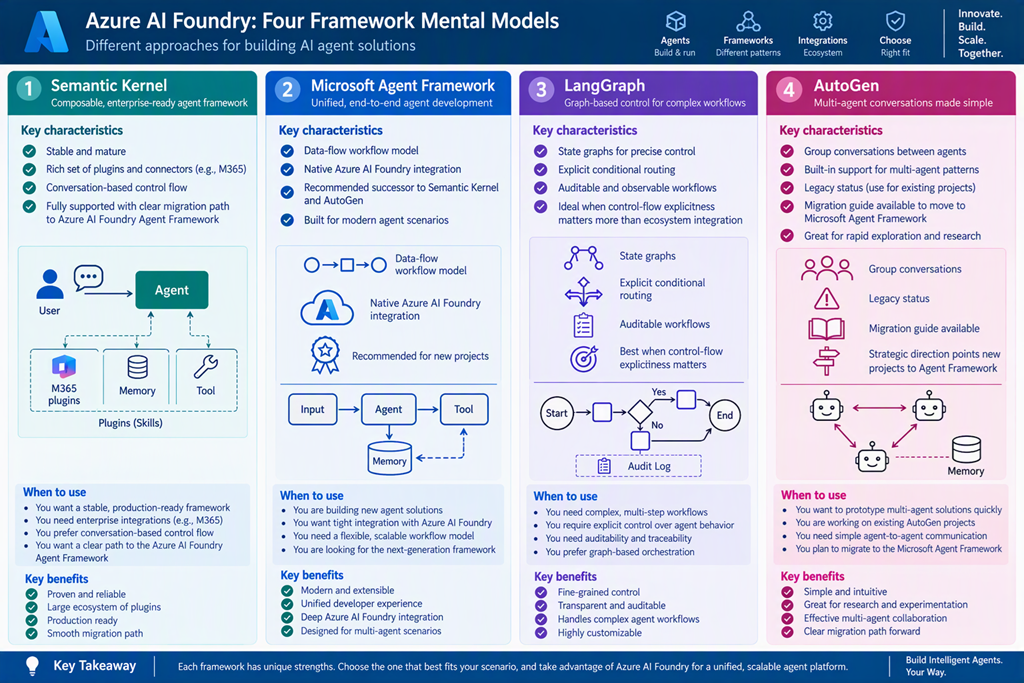
Figure 1, 4 key framework models
The most important lesson is not which framework you choose. The most important lesson is understanding the orchestration patterns that solve your problem.
Too many discussions about AI agents begin with framework selection. Teams ask whether they should use Semantic Kernel, Microsoft Agent Framework, LangGraph, or AutoGen. In reality, those decisions should come after the architectural decisions have been made.
Frameworks are not just collections of APIs and syntax. Every framework embodies a philosophy about how agent systems should be composed, coordinated, and executed. As a result, the framework you choose naturally influences the orchestration patterns that become easier to implement.
Table 1, framework comparison matrix
| Framework | Architectural Philosophy | Best-Suited Orchestration Patterns | Enterprise Alignment | Strategic Position |
| Microsoft Agent Framework | Workflow-centric agent systems with explicit data-flow orchestration | Workflow orchestration, hub-and-spoke, concurrent execution, multi-agent workflows | Deep Azure AI Foundry integration, managed identity, enterprise governance, M365 connectivity | Microsoft’s recommended framework for new agent projects and the strategic evolution of its agent ecosystem |
| Semantic Kernel | Capability-centric orchestration built around agents, plugins, memory, and skills | Hub-and-spoke, handoffs, collaborative agent interactions, conversational orchestration | Mature Azure and M365 integration with a large plugin ecosystem | Proven enterprise framework with a clear migration path toward Microsoft Agent Framework |
| LangGraph | Graph-oriented workflow execution where control flow is explicitly modeled as states and transitions | Supervisor architectures, conditional routing, stateful workflows, complex decision trees | Azure integration available through LangChain components and custom implementations | Ideal when traceability, auditability, and deterministic execution paths are primary requirements |
| AutoGen | Agent-to-agent collaboration through conversational interactions | Group chat, collaborative reasoning, distributed problem solving | Azure OpenAI integration but limited enterprise workflow capabilities | Valuable for existing implementations, though new projects should generally evaluate Microsoft Agent Framework first |
| CrewAI | Team-based task delegation with role-driven agents | Hierarchical teams, delegation chains, manager-worker patterns | Primarily model-focused with fewer enterprise platform integrations | Useful for rapid experimentation, though enterprise adoption remains less established |
For example, Semantic Kernel favors a conversational and capability-centric model. Its rich plugin ecosystem, enterprise integrations, and straightforward agent abstraction make hub-and-spoke architectures feel natural and intuitive. A central orchestrator can coordinate specialized agents, tools, memory, and external systems while maintaining a clear control flow.
By contrast, LangGraph is built around explicit state graphs and conditional routing. It excels when workflow transparency, auditability, and precise control over execution paths are more important than ecosystem integration. A graph-oriented framework models a workflow as interconnected nodes and edges, where each node represents a task, agent, or decision point, and each edge defines a possible transition between states. Rather than relying on a central orchestrator making implicit decisions, the workflow itself becomes an explicit graph that can be visualized, inspected, audited, and modified. This approach makes supervisor patterns, complex branching logic, human-in-the-loop checkpoints, and highly controlled multi-step workflows feel natural because the execution path is represented directly in the architecture. As a result, LangGraph is particularly well suited for scenarios where control-flow explicitness, traceability, and deterministic behavior matter more than deep ecosystem integration.
Microsoft Agent Framework introduces a modern data-flow workflow model and deep Microsoft Foundry integration. Rather than focusing exclusively on conversations or state graphs, it emphasizes end-to-end agent development and scalable workflow composition. For organizations starting new projects, it represents Microsoft’s strategic direction and is the recommended successor to both Semantic Kernel and AutoGen for many future agent scenarios.
AutoGen took a different approach by popularizing multi-agent conversations and collaborative reasoning between agents. Its simplicity made it extremely valuable for experimentation, research, and rapid prototyping. While existing solutions continue to benefit from AutoGen, Microsoft’s strategic direction now points toward the Microsoft Agent Framework for new enterprise projects.
These four frameworks represent four distinct philosophies:
- Semantic Kernel: Enterprise integration and composable capabilities.
- Microsoft Agent Framework: Workflow-driven, end-to-end agent solutions.
- LangGraph: Explicit state management and graph-based orchestration.
- AutoGen: Agent-to-agent collaboration and conversational coordination.
What is particularly interesting is that real-world systems rarely need to commit exclusively to a single framework. Hybrid architectures are becoming increasingly common. A team might use Semantic Kernel or Microsoft Agent Framework as the primary orchestration layer because of Azure and enterprise integration requirements, while delegating a complex decision tree or routing workflow to a LangGraph sub-workflow. The orchestration pattern remains the same even though multiple frameworks participate in the implementation.
This is why architectural thinking matters more than framework selection.
The critical questions are:
- Should the system use a hub-and-spoke model or a supervisor model?
- How should partial failures be handled?
- When should execution occur sequentially versus in parallel?
- Do tasks require quorum-based decision making?
- How should memory, tools, and state be shared across agents?
- Where should observability and auditability be enforced?
None of these are framework questions. They are architecture questions.
Once those decisions are made, choosing the framework becomes largely a tactical exercise driven by ecosystem fit, existing investments, team expertise, operational requirements, and long-term support considerations.
Learn the patterns first.
Understand hub-and-spoke orchestration, supervisor architectures, workflow graphs, parallel execution, quorum policies, hierarchical delegation, and failure recovery strategies. Once you understand those concepts, moving between frameworks becomes relatively straightforward because you are translating architectural intent rather than learning entirely new ideas.
The frameworks will evolve. New frameworks will emerge. Existing frameworks will converge and absorb ideas from one another. However, the underlying orchestration patterns will remain remarkably stable.
Architecture is strategic.
Frameworks are tactical.
The teams that understand that distinction will build agent systems that survive far longer than the technologies used to implement them.
Here is more information on this topic.