Every multi-agent system is agentic, every agentic system is not multi-agent. You can see textually some differences between them in Table 1 and Figure 1.
An Agentic system is one which would respond to and infer the following prompt:
Review this C# pull request and identify bugs, security issues, and
performance problems.
The autonomous Agentic AI chooses the action instead of executing a pipeline or multiple agents. The agent identifies the goal, determines which tools to call, observes the result and then reflects on the result until the completion conditions are met. This is an implementation decision and by that, if I were to build an agentic solution the code I write would provide the system_prompt to guide and instruct the agent how to infer the provided user_prompt. You probably know this but AI itself does not decide if it is a single agent or multi-agent on it’s own. AI must be instructed, coded, and guardrailed to perform the desired inference and to remain within the realm of control.
| AGENTIC AI | MULTI-AGENT AI |
| One Agent | Many Agents |
| Plan | Coordinate |
| Act | Collaborate |
| Observe | Specialize |
| Reflect |
Table 1, Agentic AI vs. Multi-Agent AI
When you begin you AI journey, it is often best to start with a simple workflow, or at least one which is completely and totally understood end-to-end. As you look now at the multi-agent system for inference of the same user_prompt, a question that comes to mind is: it seems that the multi-agent solution is far superior in depth than the agentic system, we should always use multi-agents? The fact is that the question is true, a multi-agent would more than likely do a better job, but it is much more complex to manage and build, and in many cases the difference will be very small, leading to the question: does the additional complexity of multi-agents generally produce greater results? To answer the question, I recommend you begin with a single agent as you will get faster results and faster impact. As it begins gaining consumption and feedback comes, you can consider updating the prompts or adding additional agents when deemed necessary.
Some examples of when a single agent meets the requirements: customer support, knowledge retrieval, document summarization, meeting analysis, basic code reviews, research with under 10-20 steps.
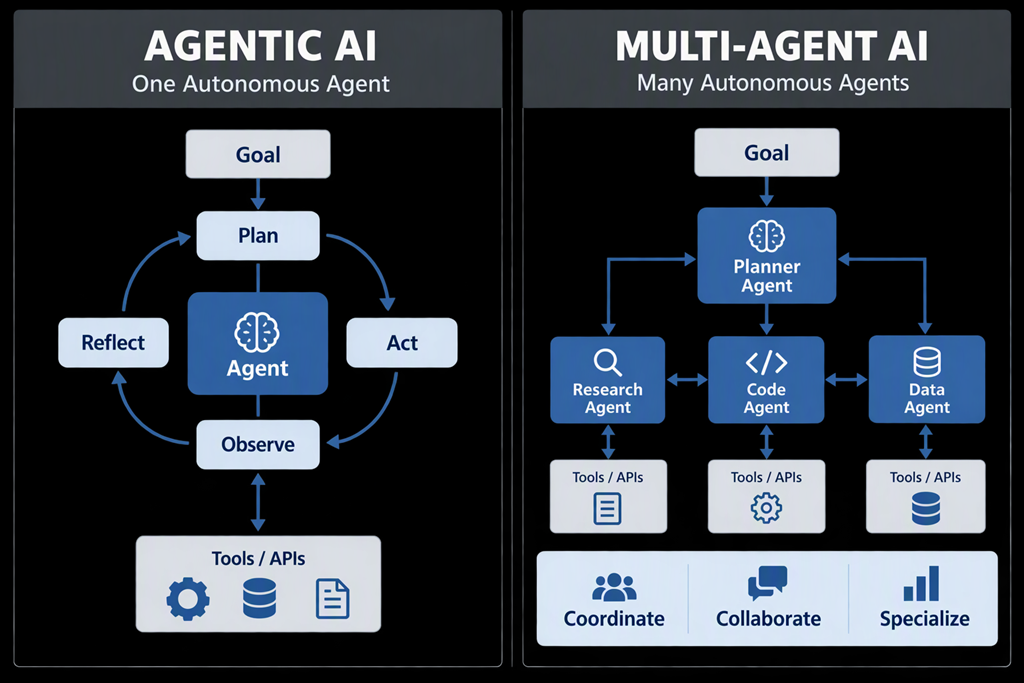
Figure 1, Agentic AI vs. Multi-Agent AI
NOTE: the term AI is used loosely, Figure 1 does not represent AI, it represents implementation patterns which can use AI (an LLM) to infer instructions (a prompt) .
You can see the difference between a single agent system and a multi-agent one in Figure 1. Specifically you see specialized AI Agents managed by a Planner Agent. Earlier I mentioned that multi-agents are more complex than single agents and perhaps just by looking at Figure 1 you can see why. Consider the fact that the planner agent or the orchestration of the the specialized agents must be coded, tested, and the specialized agents would need additional instructions on how to interact with each other and the structure of data sharing. Here is a bullet list of additional work necessary when moving from single- to multi-agent systems.
- Pattern selection (hub-and-spoke, hierarchical, supervisor)
- Inter-agent message protocols and handoff payloads
- Synchronization of parallel agent execution
- Per-agent identity, OBO chains, agent-to-agent authentication
- Distributed tracing across agents (correlated spans)
- Coordinated multi-agent release with version compatibility
- Per-agent cost attribution and chargeback
- Multi-intervention guardrails on every agent and every handoff edge
Please see my article Advanced multi-agent orchestration architectures to learn more about, hub-and-spoke, hierarchical, supervisor, etc. and why flat orchestrations break down once you have many interactive AI Agents. Figure 2, which is an AI generated image using the previous bullet points produced, I think it is wonderful.
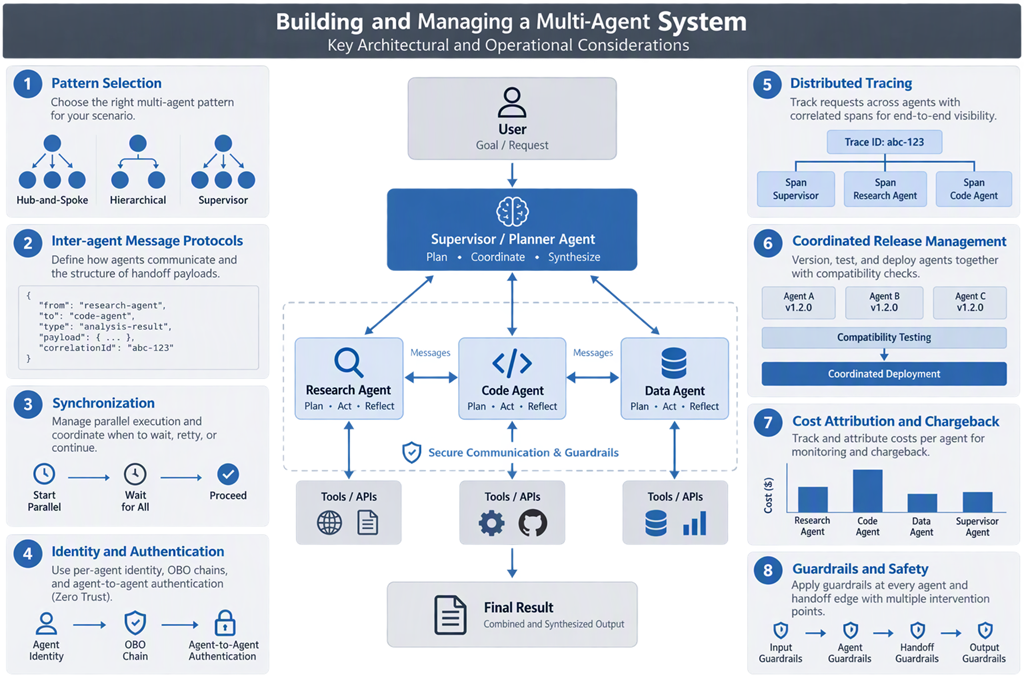
Figure 2, complexity considerations when developing multi-agent systems
The purpose of this article was to explain the differences between Agentic AI (single agent) and multi-agent systems. I learned a lot writing it and I hope you learned something reading it.
Here is a link with more information.