In a previous article, The difference between Agentic AI and Multi-Agent Architectures, I touched on multi-agent systems and briefly on pattern selection. This article will discuss those 3 patterns in more detail.
In this article, Orchestrate a multi-agent solution using the Microsoft Agent Framework flat / foundational orchestration patterns were discussed. They are Concurrent, Sequential, Handoff, Group Chat, and Magentic One. These patterns are viable for between 3 to 10 agents, after which you must implement a more robust orchestration pattern. In this flat model there is no hierarchy, meaning all agents infer and communicate on the same level. As the number of agents increase beyond 10, foundational patterns begin to fail because of the following:
- Ownership of conflicts – what to do when agents produce conflicting outcomes, flat patterns have no hierarchy for decision making
- Coordination overhead – the more agents the greater number of coordination between them
- Unpredictable cascading failures – continue with incomplete or incorrect outcomes, or abort the workflow
The 3 advanced multi-agent orchestration patterns that are useful for managing a multi-agent system with over 10 AI Agents are shown in this AI generated Figure 1.
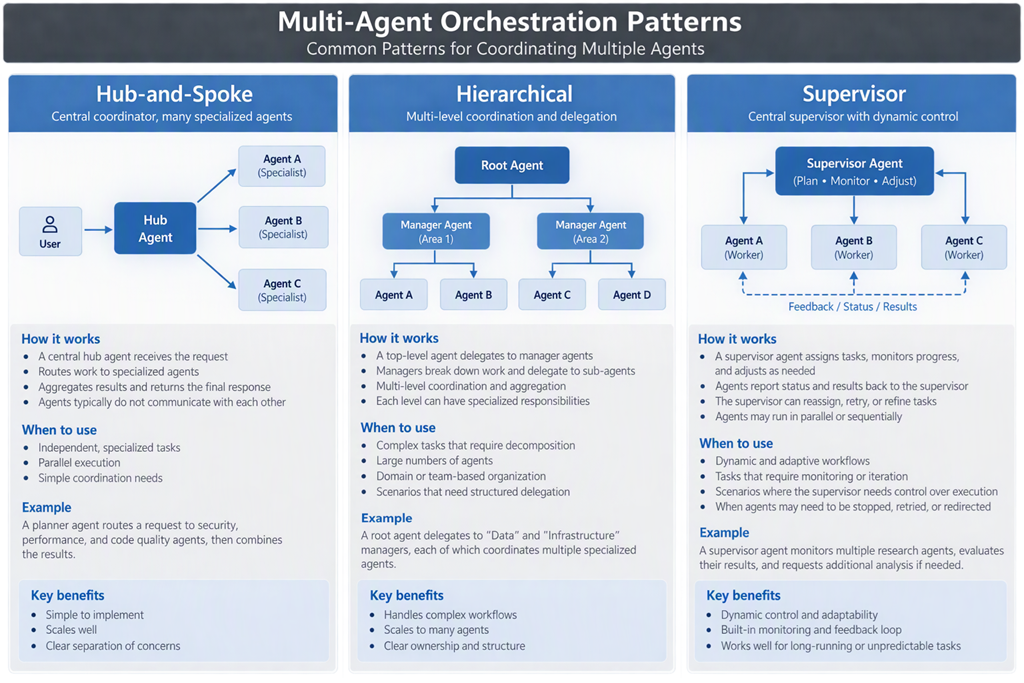
Figure 1, advanced multi-agent orchestration patterns, hub-and-spoke, hierarchical, supervisor
Here are some additional details regarding these advanced patterns. It is always a good idea to begin with a plan, models, and a pattern. That is important when you are architecting a system of any kind. It provides a point of reference when you are down in the trenches coding and have wondered down the wrong path. If that happens review the architecture design and get back on the right path.
Hub-and-Spoke
The Hub-and-Spoke pattern uses a central coordinating agent that receives requests, dispatches work to specialized agents, and aggregates the results into a final response. The specialized agents are typically independent and do not communicate directly with one another. The hub is responsible for orchestration, routing, and synthesis. This pattern works best when tasks can be decomposed into independent pieces of work that do not require collaboration between agents. Each specialist analyzes a different aspect of the code and returns findings to the Hub Agent, which compiles a consolidated review report.
Trade-offs
As the number of agents increases, the Hub Agent can become a bottleneck. All orchestration logic, retries, monitoring, and aggregation are centralized, which may limit scalability and resilience.
Hierarchical
The Hierarchical pattern introduces multiple layers of agents. Instead of a single coordinator, higher-level agents delegate work to mid-level manager agents, which then coordinate groups of specialized agents. Each level is responsible for coordinating the agents beneath it.
Trade-offs
Hierarchical systems can introduce latency because information must travel through multiple layers. They can also become harder to debug when failures occur deep within the hierarchy.
Supervisor
The Supervisor pattern introduces an active supervisory agent that continuously monitors the execution of worker agents. Unlike Hub-and-Spoke or Foundational Orchestration, the Supervisor does more than delegate work. It observes progress, validates results, makes decisions during execution, retries failed tasks, redirects work, and adapts plans as conditions change. Worker agents continually report status back to the Supervisor.
Trade-offs
The Supervisor can become a critical dependency. Designing effective monitoring, intervention, and decision policies can significantly increase implementation complexity.
Choosing the correct pattern
A practical rule is:
- Start with Hub-and-Spoke for most projects.
- Move to Hierarchical when coordination scales beyond a single orchestrator.
- Use Supervisor when agents must be actively monitored, redirected, or improved during execution.
| Pattern | Best for | Complexity |
| Hub-and-Spoke | Independent parallel tasks. Workflow is mostly deterministic with known spoke invocation sequences | Low |
| Hierarchical | Large-scale systems with many agents. Clear organizational boundaries between agent clusters; sub workflows evolve independently | Medium |
| Supervisor | Dynamic workflows requiring monitoring and adaptation. Agent quality varies; outputs need validation before downstream use | High |
In my next article I Implement a hub-and-spoke orchestration. Here is a great article discussing this further.